

18 September 2026
124 Miles, 5 Days, No Generator, No Shore Power
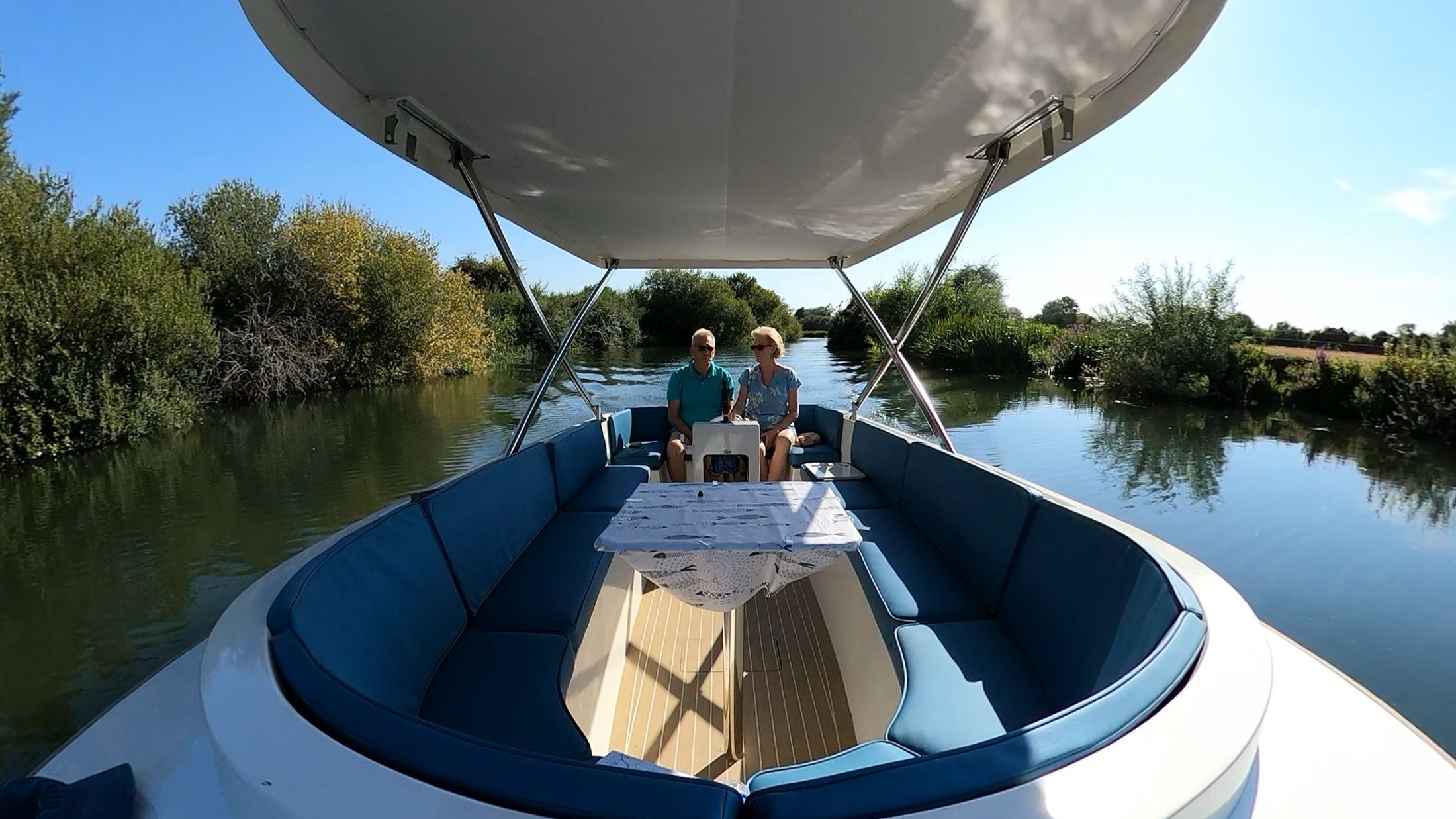
Torkmar co-founder Tim Knox and his wife Sue have completed a five-day, 124-mile passage down the River Thames aboard the company’s DB1 solar-electric dayboat, run entirely on solar charging with no generator or shore-power top-ups at any stage and Torkmar is releasing the full power log from the trip.
The passage, from Lechlade to Teddington, ran during a summer heatwave and drought, which brought hard lock restrictions to the upper river and gave a genuine stress test of DB1’s 5kWh lithium battery bank and 756W overhead solar array.
Power figures from the log:
- Gentle cruising: 0.25kW draw at 3.5–3.8mph
- Pushing for a lock: 0.5–0.6kW draw at 4.2–4.8mph, with consumption roughly doubling
- One hard 0.6kW push near Culham Lock held 4.8mph for half an hour, costing 6% of charge, with what Knox described as no motor noise and next to no wash
- Solar input: approximately 350W at midday
- Total consumption over the passage: 1.5kWh
- State of charge: opened day one at 100%, dipped to a low of 60% after the Whitchurch Lock delay, and closed day five at 70%
Day one saw drought-restricted locks from Lechlade to Oxford running only on the hour and half-hour, between 9.30am and 6pm. DB1 covered nearly 30 miles on 1.5kWh, finishing the day at 73% state of charge. A weed hatch built into the hull over the winter — Knox called it “very unusual on a dayboat” — meant clearing prop fouling, previously a job that meant diving in, now took under a minute from inside the boat.
Day two took the boat through Oxford with YouTuber David Johns of Cruising the Cut filming aboard for a Mothership Torkmar video release, and Knox gave a live interview to BBC Radio Oxford about the trip. Overnight charging and gentle cruising had lifted state of charge to 75% by the time the crew pushed on to make a restricted lock at Culham for David Johns’ return transport.
Day three’s failure at Whitchurch Lock was caused by debris pushed into the gates by larger boats leaving the lock too quickly, preventing the gates from closing. The fix — manual clearing with a pole — took over two hours, forcing a late, unrestricted push into Henley that closed the day at 60% state of charge, the lowest point of the trip.
Day four ran Henley to Windsor with no lock restrictions in effect, allowing gentler cruising that recovered charge to 69% by day’s end.
Day five closed the loop from Windsor to Teddington under renewed restrictions, arriving on a high tide as water pushed into the non-tidal Thames, with the battery bank at 70% state of charge — recovered from the day three low with no external charging at any point.
The headline is the battery recovered every single day on solar alone, even after a two-hour delay and a run of hard cruising to make lock times. That’s the number that matters for anyone weighing up range anxiety on an electric boat.
Tim KnoxDB1 pairs a 1.5kW Torkmar PMAC direct-drive motor with a 14-inch propeller matched to its torque curve, a 5kWh lithium battery bank, and a 756W solar array capable of sustaining cruising speeds up to 4mph in good daylight. The boat measures 19'6" x 7'4" and seats up to six.
Torkmar is highlighting the automated solar canopy as a point of difference from other electric and solar-assisted dayboats on the market. The roof raises to collect solar power on the move, then lowers under remote control to fully enclose and secure the boat when moored, removing the need for canvas covers, poppers or press-studs. Combined with a propulsion system that never requires plugging in, Torkmar says the setup means DB1 can be kept on a swinging mooring rather than requiring a marina berth with shore power.
Torkmar plans to publish the passage data as a downloadable case study for dealers and prospective owners assessing solar-electric propulsion for inland cruising, alongside video footage from the trip on the company’s YouTube channel, Mothership Torkmar.
About Torkmar
Torkmar designs and manufactures electric propulsion systems for inland and coastal boats — motors, lithium battery banks, and integrated power hubs — for boat builders and DIY boat owners. Based at Oundle Marina, Northamptonshire.