

5 January 2026
When Wave International launched its first bilge water filter systems designed to prevent oil and diesel and other pollutants from being emitted into the oceans and waterways 25 years ago, founder Paul Gullett recognised that it was going to be an uphill struggle to encourage major boat builders to fit non-obligatory marine environmental systems into their craft.
Having previously worked in marine and the offshore oil and gas industry, I was aware of how critical it was to keep oil and diesel from being discharged into the marine environment. In 2000 Wave International was set up and launched the Wavestream bilge filter systems, knowing that the marine sector was also starting to recognise the importance of keeping our oceans pollution-free. It was difficult at that time to persuade leisure boat builders to add another component which was not a legal requirement.
Paul Gullett, MD of Wave InternationalWave International, which manufactures its sophisticated filter systems in the UK, appointed Halyard (M&I) Ltd as its UK distributor, and together they started to publicise Wavestream systems to the major UK boat builders.
The Wave range of filtration systems is one of Halyard’s key distributed product lines and perfectly complements Halyard’s strategy of providing leading edge technical products that improve the environment for boat owners, crew, guests, and other water users. Sunseeker International Ltd were an early adopter of the Wavestream bilge filter and continue to install it across their range of boats demonstrating their genuine commitment and responsibility to the environment.
David Johnson Managing Director at HalyardWavestream bilge filters have been fitted as standard into all Sunseeker craft ranging from the Hawk 38 to the 100 Yacht for the last 20 years. The sophisticated filter technology developed by Wave International not only prevents any oil or diesel from being pumped overboard, but also captures microfibres and microplastics, such as paint particles*, chemicals and other pollutants.
We worked closely with Wave International and Halyard to understand how the Wavestream bilge filter system could be integrated into our craft. It was critical that it was fully approved, reliable, compact and easy to install, and also positioned where users can easily change the filters on an annual basis. For our customers, it added to our credentials as a company that prioritised minimising any adverse effect on the environment.
Jon Robins Head of Engineering Design at Sunseeker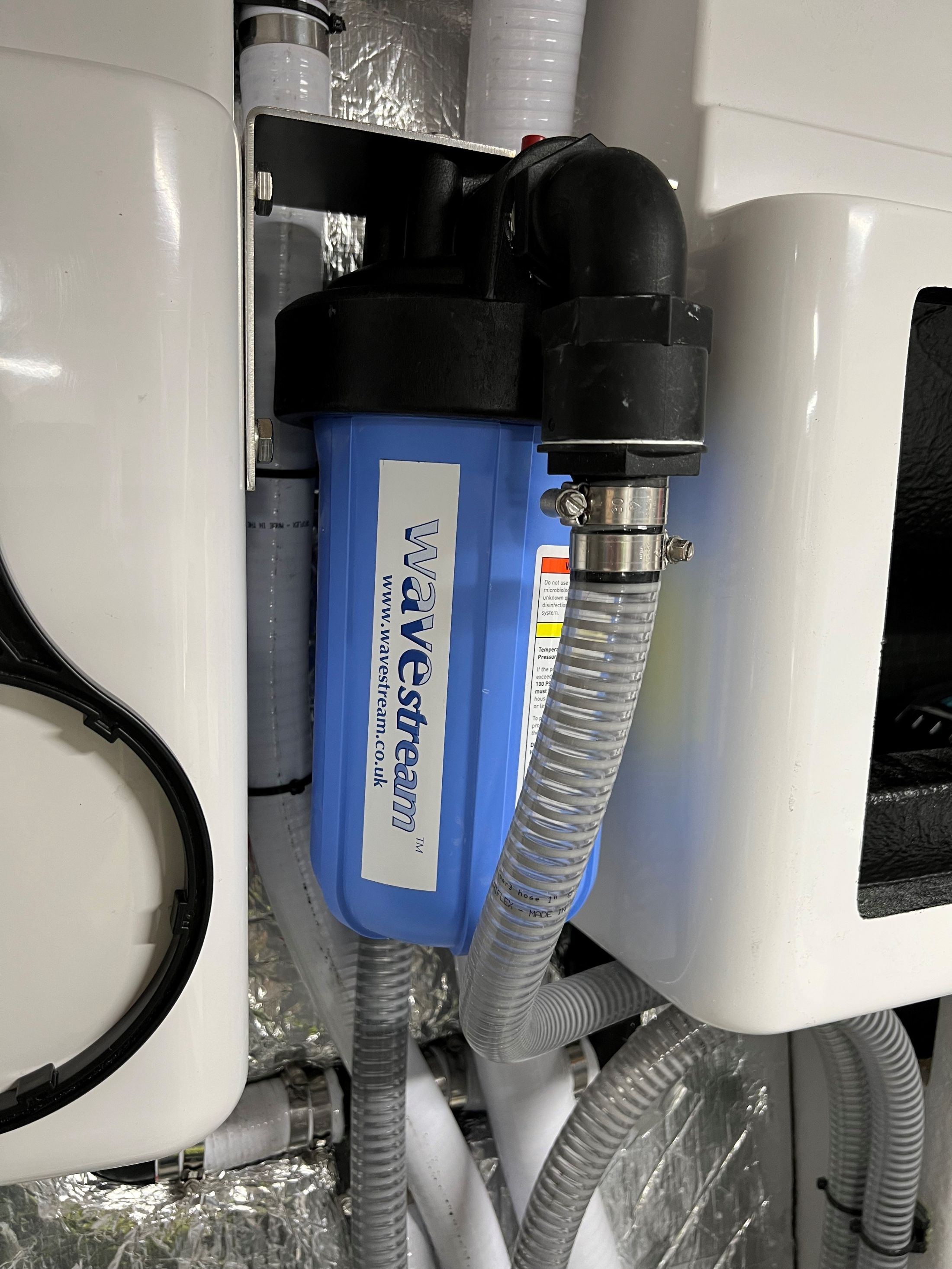
Boaters are often unaware of the implications of emitting oil or diesel from their bilge water, which is often visible on the water as blueshine. Just one drop of oil in 0.5 litre of water equates to a pollution level of 40 parts per million. Anything over 15 ppm, or 5 ppm in inland waterways and in special areas, exceeds the discharge regulations set by the Environment Agency in the UK and by other marine authorities worldwide, and covers increasingly large areas as more Marine Protected Areas (MPAs) are established, adding to well-known locations such as Galapagos.

More information about Wave International products can be found at www.waveinternational.co.uk or www.halyard.eu.com
As Wave International celebrates its 25th anniversary, Gullett reflects on how far the marine industry has progressed in terms of understanding the importance of protecting the environment.
When we set up 25 years ago, it was before The Green Blue, which is an RYA and British Marine enterprise, before companies saw environmental protection as a priority and before consumers prioritised their purchasing decisions on a brand’s environmental credentials. And even now, with so much focus on using electric as a main means of propulsion, we see how much oil, diesel and microplastics and microfibres are captured in Wavestream filters, proving these small, easy to fit and affordable systems really work to protect the marine environment.
*A study undertaken by E-A Earth Action reveals that paint particles appear to be the largest source of microplastic leakage into the ocean and waterways. Accounting for more than half (58%) of all microplastics, the report says paint particles outweigh all other sources of microplastic leakage, such as textile fibres and tyre dust.
E-A Earth Action Report: https://www.e-a.earth/wp-content/uploads/2023/07/plastic-paint-the-environment.pdf
E-A YouTube video here: https://www.youtube.com/watch?v=Kag7RevqEmw